The Problem
First semester Georgia Tech Students cannot walk properly. They walk in the roads, in the grass, and at 0.01mph on sidewalks. I set out to find a solution to this pressing issue before next fall.
Brainstorming
I considered several solutions to this problem.
The first, and easiest, is simply asking them to move. But as we all know, Georgia Tech Students are notoriously introverted, and most of them are listening to music or talking to friends instead.
I next considered walking around them. Another simple solution, but one that requires considerable effort on behalf of the user, and is not always possible.
Being an engineering student, I next considered an engineer’s solution to this problem. I designed a system that is able to detect the distance to the person in front of you, and activate and audiovisual alarm indicating to them that they should pick up the pace.
The Walk Faster Alarm
I named this device the walk faster alarm, and started designing
This was my original circuit diagram in KiCad
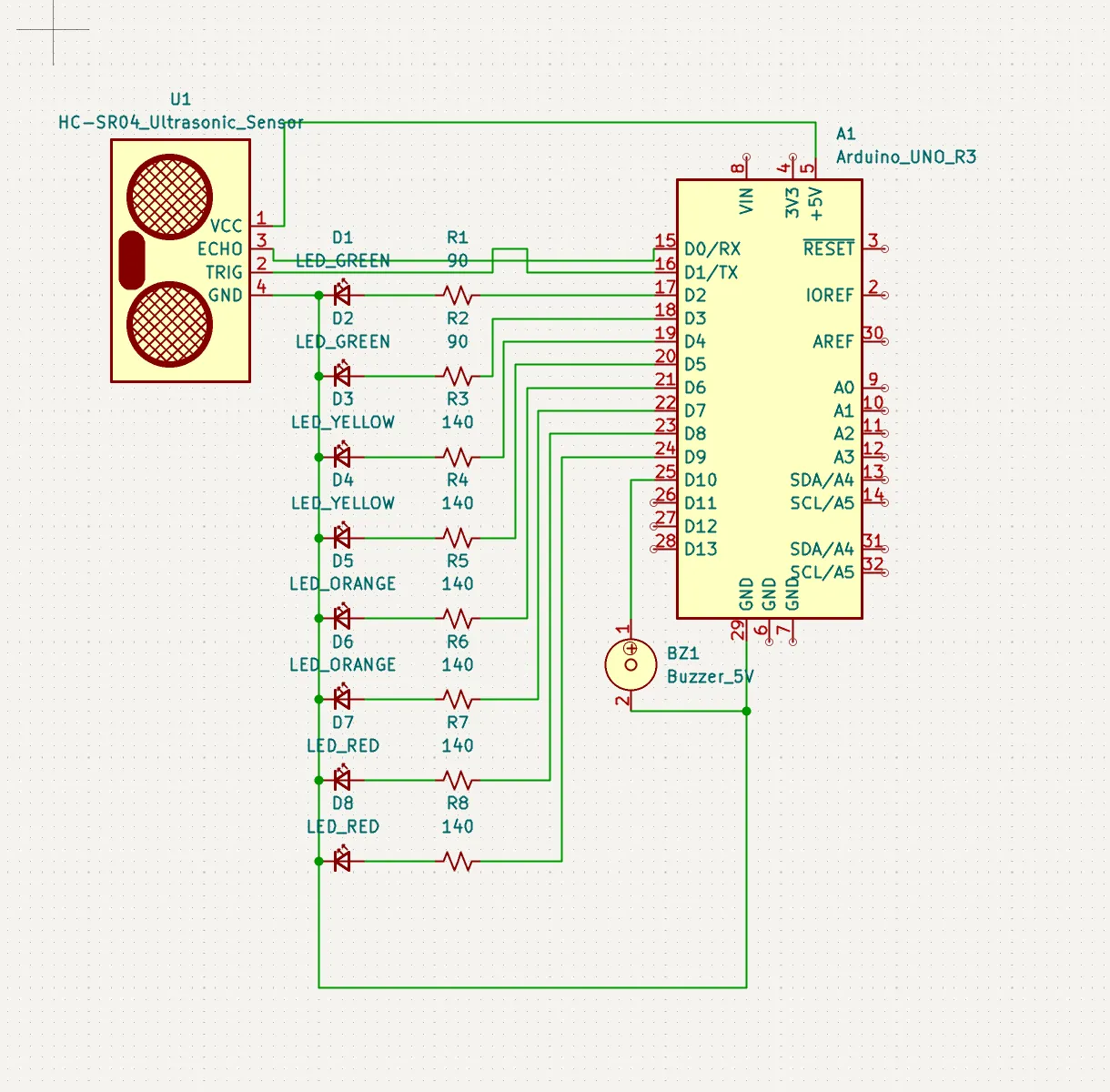
The ultrasonic sensor is wired in to the left, and the buzzer is shown in the bottom right. The LEDs are done in an array structure with one pin powering each LED through an appropriately chosen resistor.
Initial Prototype
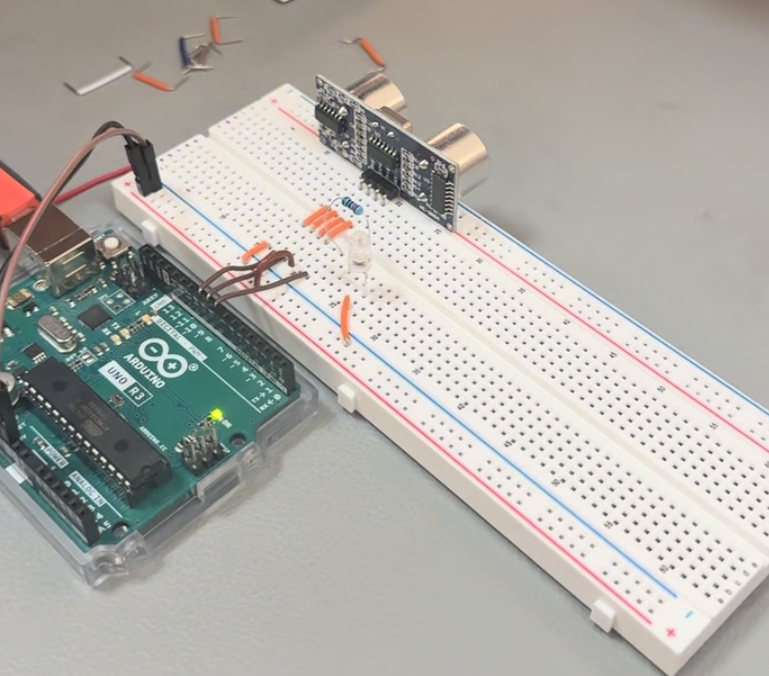
I built my initial prototype on a breadboard using materials from the HIVE.
This board used my original circuit design with an individual wire for each LED. While this worked, I wanted to investigate other solutions.
Shift Registers
Enter a shift register, which allows you to control multiple outputs with just 3 wires, data, clock, and clear. Arduino offers a library to work with shift registers.
Second Prototype
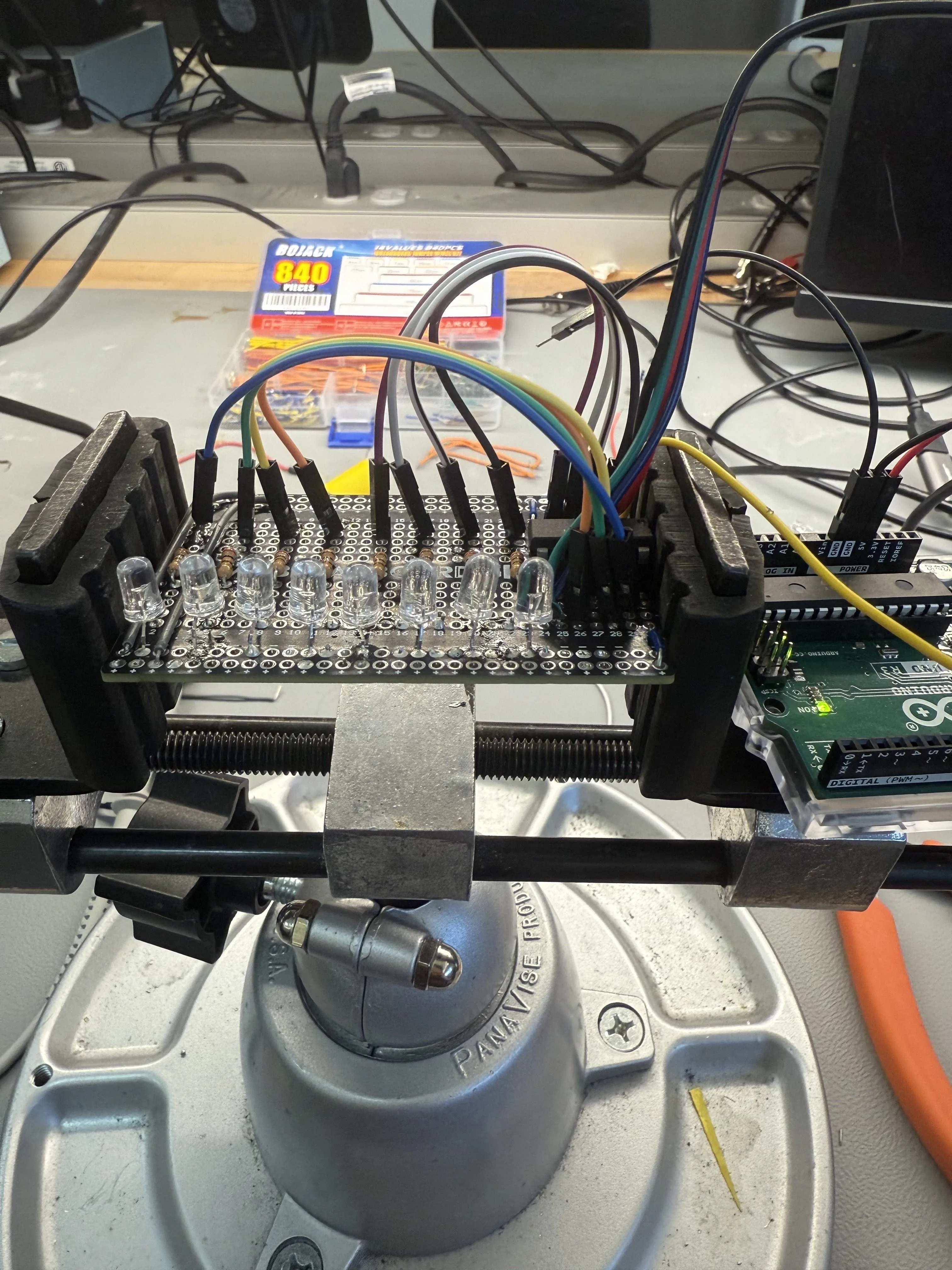
I worked with a shift register chip to trigger the 8 LEDs from the data cable. I was able to get this working with a simple example that flashed the LEDs in sequence
Integration Issues
It was then time to integrate these 2 systems. Unfortunately I ran into some issues here. The systems worked well separately, but I was unable to get them to work together. Specifically working with the shift register was causing me trouble. This was near the end of my project timeline, so unfortunately I wasn’t able to complete this portion of the integration.
Successes and Failures
Successes
I was able to get both systems working separately. The shift register circuit worked, and the ultrasonic sensing worked.
Shortfalls
Unfortunately I was not able to get both systems working with each other, I’m confident that with more time, troubleshooting, and access to the HIVE’s facilities that I could get these two systems working together.
ECE Skills
This project required several basic ECE skills to be put together for the final product. These included Arduino programming, soldering, and basic circuit design. I also used math learned from Physics 2212 to determine the proper resistor size for all of my LEDs.
Final Reflection
Overall, even though I wasn’t able to fully finish this project, I still learned a great deal. I was able to utilize several ECE skills as previously detailed, and I made good use of on campus resources. This project was my first introduction to The HIVE Makerspace, and I’m sure I will be making good use of the space as I get further into my degree specific courses. I would like to continue troubleshooting this project to get it fully functional at some point in the near future.